
Should you treat the hip for low back pain?
Does treating the hip improve low back pain? A 2021 randomized trial shows no added benefit. Learn what actually drives recovery and effective physical therapy.

Low back pain continues to be one of the most common reasons patients seek physical therapy. The more concerning issue is that non-specific low back pain, which accounts for approximately 90% of all low back cases, is widely under diagnosed due to the complexity of the region. Once red flags and specific mechanisms of injury are excluded, any combination of musculoskeletal, neurological and psychosocial factors can elicit symptoms in the low back.
Recently, there has been a growing emphasis on the role of the hip, particularly when patients present with limited mobility, weakness or asymmetries. In the clinical setting, it is now common to hear that “tight hips are causing your back pain”, or “weak glutes are the problem.”
But an important question remains.
Does treating the hip actually improve outcomes in patients with low back pain?
A 2021 randomized controlled trial published by Burns et al set out to answer this directly.
The study
This randomized controlled trial study evaluated whether adding hip-specific treatment to standard low back physical therapy led to better outcomes.
Participants were 76 adults with 1) low back pain and 2) concurrent hip impairments, which included mobility and/or strength deficits of the hip. These participants were then divided into two groups:
Group 1 was given Lumbar Treatment Only (LBO).
Group 2 was given both Lumbar + Hip Treatment (LBH).
Both groups received standard physical therapy for the low back, including 1) exercise, 2) manual therapy and 3) patient education.
The hip-treatment group received additional interventions, including 1) hip strengthening, 2) mobility work and 3) manual therapy targeting the hip.
It is important to note that the lumbar treatment was not strictly standardized—it was based on clinician judgment, reflecting real-world physical therapy practice.
Outcome measures included 1) pain (Numeric Pain Rating Scale), 2) disability (Oswestry Disability Index), 3) fear-avoidance beliefs, and 4) functional improvement.
Patient follow-up was obtained at baseline, 2 weeks, discharge, 6 months and 12 months post-intervention.
The results
Both LBO and LBH groups improved significantly over time, but there was no additional benefit from hip treatment.
In other words, there were no meaningful differences between groups at any time point.
The interesting finding, however, was that the group receiving additional hip treatment had higher fear-avoidance beliefs at 2 weeks and discharge. This subtlety may suggest that additional treatment may not necessarily improve patient confidence or outcomes.
Limitations of the study: 1) variability in treatment approaches. The details of low back treatment were not included, and it was based on therapist discretion to mimic real-world applications. However, without standardization of what low back care entailed, we do not know whether there were inadvertently hip-involved interventions used within the LBO group. 2) The study was not blinded, meaning that patients and therapists knew which group they were placed under. This increased the risk of both observer and participant expectation bias, which could vastly affect the results. 3) The education aspect of care, while directed to be centered around the low back, may have also included the hip. 4) Small sample size and missing data at follow-up.
Clinical implications for physical therapists
At first glance, the study’s findings challenge the common assumption that, “if the hip is impaired, treating it will improve low back pain.” Rather yet, the study suggests that identifying and addressing a hip impairment does not necessarily benefit low back pain, and that improvements may be driven more by general movement, load tolerance and gradual return to activity.
The conclusions of the study suggest that, for most patients with low back pain, focusing treatment on the spine alone may be sufficient—even when hip deficits are present. But were the participants in the “low back only” group truly receiving treatment exclusive to the low back? Learning lumbopelvic awareness through a cat-cow exercise will also affect movements in the hip. Education on protection of the low back includes promoting movement in the hip to offload the spine. Even without targeted hip interventions, it is unlikely the hip was truly ignored. Unless we know that the experiment’s “low back only” group was truly limited to the lumbar spine (ie. core strengthening, spinal mobilizations) we should be cautious to jump to the conclusion that focusing on spine alone suffices.

Nonetheless, the study does provide standard procedures for the participants who received additional hip treatment. This included specific manual therapy procedures and a progressive exercise protocol for the hip. And even so, this group did not perform better than the other, strengthening the conclusion that adding hip-specific work does not necessarily provide additional benefit.
The focus is then as such: More is not always better. The goal is precision, not excess. Overcomplicating care can reduce clarity for the patient and shift focus away from meaningful progress. Therefore, while a patient can indeed have “tight hips”, “weak glutes”, or “muscle imbalances”, these are not always the primary drivers of pain. Training hip stability and mobility have almost become synonymous with low back pain protocols, and it’s important that we take a step back and acknowledge the distinction between the two.
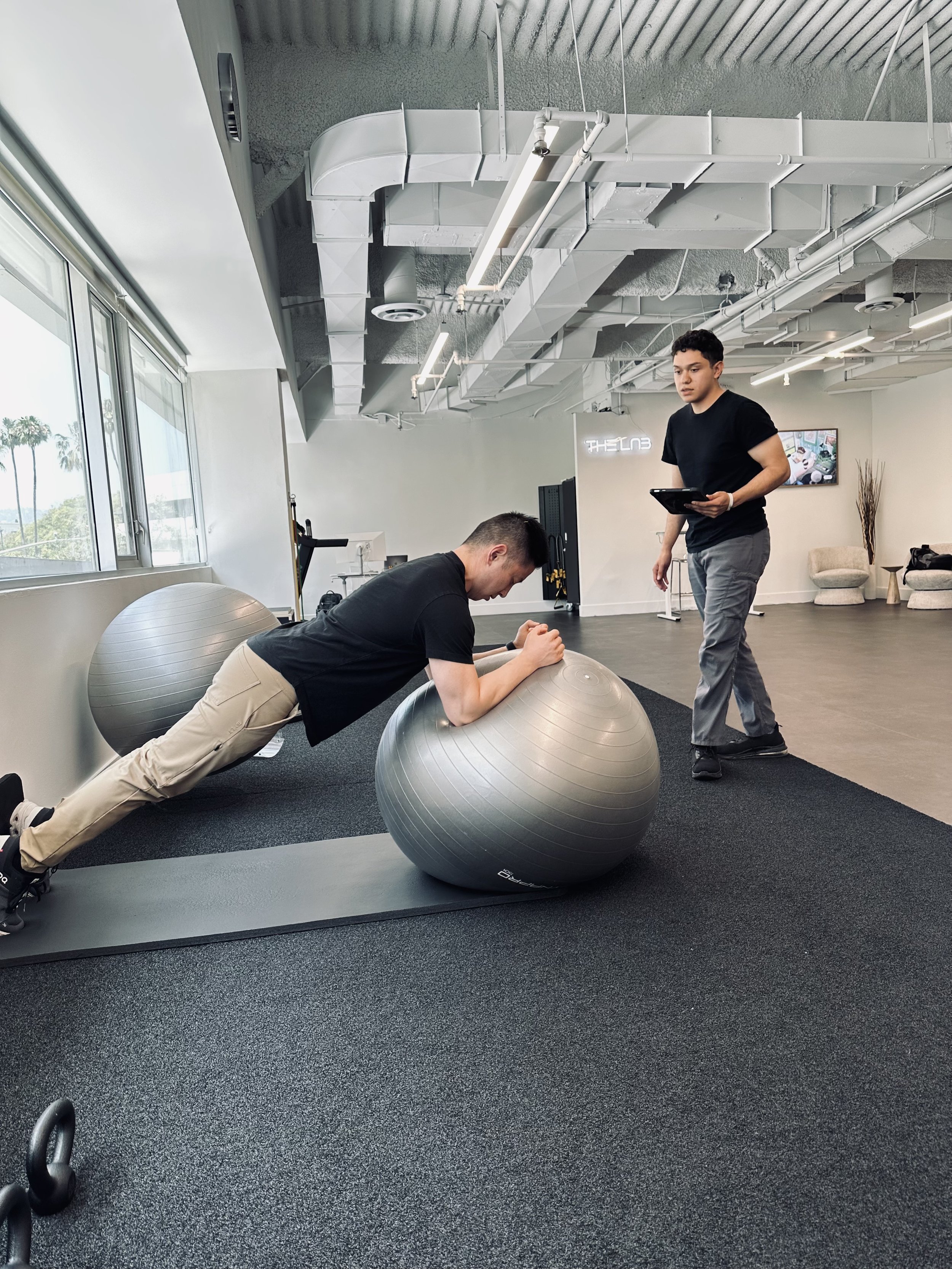
Final thoughts? This study reinforces an important yet forgotten principle in rehabilitation: effective treatment is not about doing more—it’s about doing what matters most.
At The LAB Doctors of Physical Therapy, we build an evidence-based treatment program that is both effective and efficient. Click here to learn more about our services.
Citations
1.) Burns SA, Cleland JA, Rivett DA, O’Hara MC, Egan W, Pandya J, Snodgrass SJ. When treating coexisting low back pain and hip impairments, focus on the back: adding specific hip treatment does not yield additional benefits: a randomized controlled trial. J Orthop Sports Phys Ther. 2021;51(12):581-601.
Chronic low back pain: exercise, walking, or both?
The management of chronic low back pain has always been a popular issue. This article looks at a study comparing different forms of exercise and its impact on low back pain.

The great dread that is low back pain (LBP) will affect 80% of Americans at some point in their life. Especially since the coronavirus lockdown, The LAB has seen a sharp rise in LBP cases due to more people working on their laptops from home.
The study:
A randomized controlled trial by Suh et al looks at the impact of different exercise protocols on individuals with chronic low back pain (>3 months).
Group 1: Flexibility exercise (FE)
Group 2: Walking exercise (WE)
Group 3: Lumbar stabilization exercise (SE)**
Group 4: Lumbar stabilization combined with walking exercise (SWE)**
**SE exercises targeted the transverse abdominis, rectus abdominis, erector spinae, multifidus, internal obliques and quadratus lumborum.
All groups underwent their designated exercise program for 30-60 minutes, 5-6 times a week, for a period of 6 weeks. These exercises were performed on their own at home. All participants were also educated on optimal posture and the abdominal bracing method, which was encouraged to be used throughout exercise.
The main outcome measures were subjective pain (VAS) during rest and physical activity, while the secondary outcome measures included the Oswestry disability index questionnaire, Beck depression inventory, frequency of medicine use, strength of lumbar extensors and endurance of postural positions. These measures were taken just before the first session, 2 weeks after last session, and 6 weeks after last session.
The results:
All groups experienced significantly less pain during physical activity, improved scores in the Oswestry disability index and Beck depression inventory, after the 6-week program.
The FE and SE groups experienced significant less pain during rest after the 6-week program.
The WE and SWE groups had significant increase in postural endurance for prone, supine and sidelying positions.
What it means:
Limitations behind the study include the absence of a control group, lack of long-term follow-up, and a small sample size (n=48).
All groups, despite their differences in exercise programs, experienced positive outcomes with respect to low back pain and tolerance to everyday physical activities. While this reiterates the benefits of general exercise for the low back, the author believes the study’s positive findings may also be attributed to the education that all participants received on optimal posture with ideal pelvic alignment for lumbar lordosis and activation of erector spinae, as well as the abdominal bracing method to maintain activation of the transverse abdominis and internal oblique musculature.
See below for examples of low back pain exercises.
REFERENCES:
Suh JH, Kim H, Jung GP, Ko JY, Ryu JS. The effect of lumbar stabilization and walking exercises on chronic low back pain: A randomized controlled trial. Medicine (Baltimore). 2019 Jun;98(26):e16173. doi: 10.1097/MD.0000000000016173. PMID: 31261549; PMCID: PMC6616307.